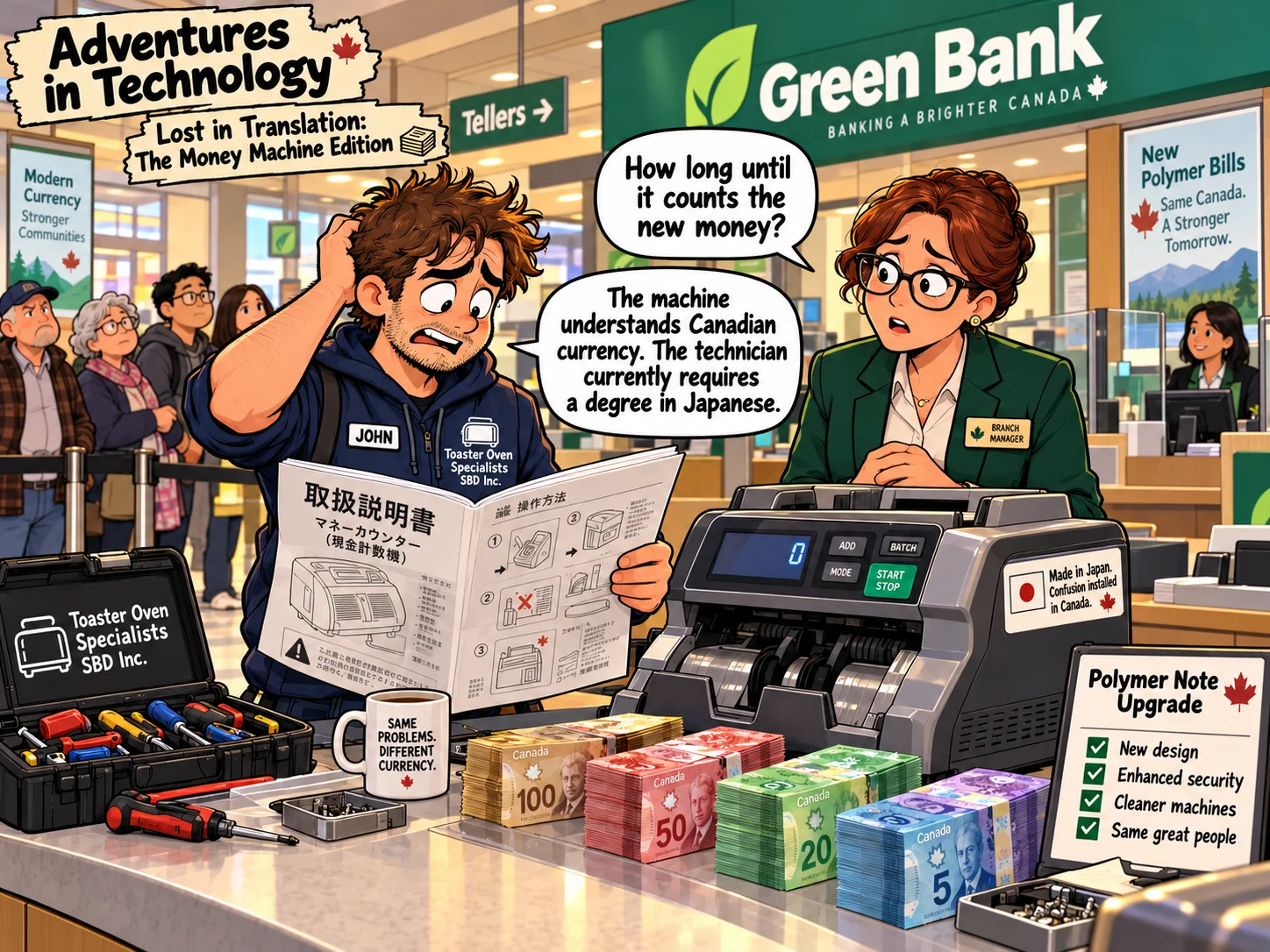
When Canadian banknotes went plastic, the cash counters needed upgrades—and the instructions arrived in Japanese.
There was a time when Canadian money was made of paper.
Then somebody decided the future was plastic.
Polymer banknotes were a wonderful innovation. More durable, harder to counterfeit, and apparently capable of bringing an entire generation of cash-counting machines to their knees.
At the Toaster Oven Specialists, we had a contract servicing cash-counting equipment for banks across Western Canada.
So when the new polymer bills started arriving, our service calls suddenly became rather interesting.
The machines needed upgrades.
The manufacturer had thoughtfully supplied the necessary updates.
And instructions.
Beautifully printed instructions.
In Japanese.
Now, I have nothing against Japanese. It's a perfectly good language.
I just hadn't realized that servicing Canadian banking equipment was going to require becoming bilingual in something considerably more complicated than English and French.
There I was, standing in a bank with a cash counter opened up, a stack of plastic money on the counter, and a technical manual that might as well have been instructions for assembling a nuclear submarine.
The bank staff wanted to know how long the upgrade would take.
I wanted to know which button meant Continue and which one meant Congratulations, you've turned your cash counter into a toaster.
Those first few service calls were an educational experience.
Eventually, somebody located the English instructions.
Suddenly, the upgrades became considerably less mysterious.
And we discovered that the equipment had been perfectly capable of counting Canadian money all along.
It was the technicians who needed the language update.
Another proud chapter in the XMAS ISL School of Engineering.
Lesson learned: Before upgrading the machine, make sure the technician can read the instructions.